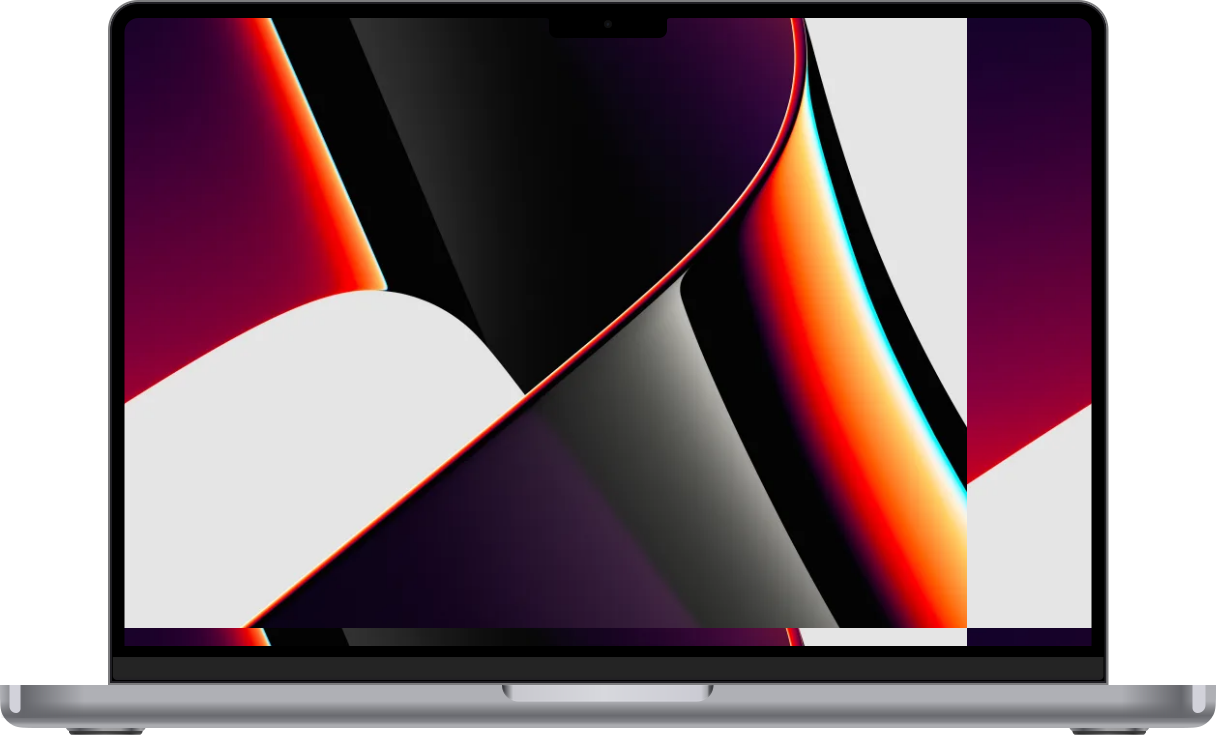
Claude Code is working. You're somewhere else. ARMA Island puts every session in the black space above your screen — what it's doing, what it needs, and one click back to the exact terminal tab.
Apple-notarized · Requires macOS 14 · 8 MB · No account, no cloud, no telemetry
ARMA Island
⚙ ✕
She reacts to the load, not just to whether something is running. One agent looks different from four — and an agent that needs an answer looks different from both. Every state is an animation, not a status dot.
Call her with ⌥⌘I. She opens as a square under the notch and tells you what's running — out loud, in a voice already on your Mac. No microphone, no permission to grant, and still nothing sent anywhere. Press it again and she's gone.
Don't like her? Drop your own artwork into a folder and it replaces her, one mood at a time — PNG, SVG or video. The folder is watched, so it changes while you're looking at it.
An agent that needs you and can't reach you is just a stopped agent.
Every session at a glance — the prompt you gave it, the file it's editing right now, its task list, and how long it's been going.
When Claude Code asks permission, the island opens itself and shows you what it wants to run. Allow or Deny right there. It stays open until you decide.
Click a session and land in the exact window and tab it's running in — iTerm, Terminal, Ghostty, Cursor, VS Code.
A sound when a run finishes. Pick it, or turn it off. You'll know a build ended from the other side of the room.
So it holds the rest of the small things you reach for all day.
Spotify, Music and Chrome. Scrubber, transport, and a level meter — with the playhead run from a local clock rather than by asking the player thirty times a second.
Your recent copies, one click to put one back. It refuses to store anything an app marks as a password or a secret.
Accent colour, motion, sound, and your own artwork for the face. Calm mode makes it genuinely still, not merely slower.
Nothing animates behind a locked screen, a sleeping display, or in Low Power Mode. The video doesn't even start until the card is open.
It installs its own Claude Code hook and merges into your settings without clobbering the hooks you already have. Launch it and it's working.
On a Mac without one it draws its own pill in the same place. Same island, same behaviour.
Not a policy — a property of how it's built. There is no networking code in the app at all. It makes no requests and holds no sockets while running. There is no server for it to talk to.
Your licence is verified with a signature, not a lookup. We don't learn that you installed it, when you run it, or how you use it. Read the privacy page →
Agents changed the shape of a working day. You start something, go and think about something else, and come back to find it finished twenty minutes ago — or worse, stopped four minutes in because it wanted permission and nobody was watching.
The notch is the one part of the screen you always look at and never use. It's above every window, it's already black, and it's in your eyeline. That's the whole idea.
ARMA Island is a small, deliberate tool. It is not a platform. It has no account, no cloud, and no plans to grow into one. You buy it once and it keeps working.
Or download the free trial first — it's the full app, and you don't need to talk to anyone.